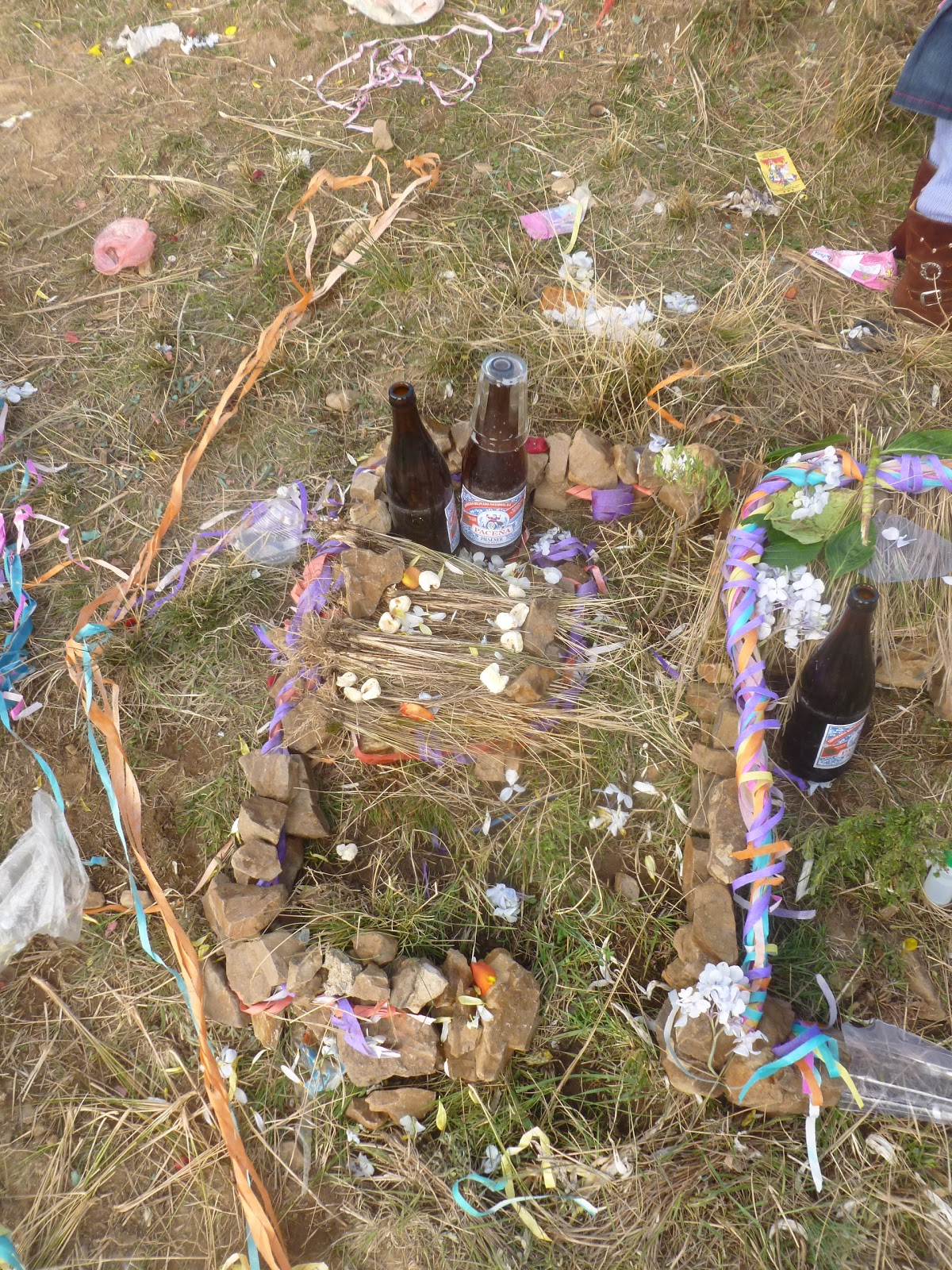
Last Saturday I accompanied my friend Valerio (from the Alpaca-herder community of Qullpani in the highlands of Bautista Saavedra) to the town of Laja, almost an hour´s drive away from El Alto in La Paz, where a curious event was taking place.
Saturday was the fiesta for the patron saint of Laja, the Virgin de la Concepcion. Apparently we had already missed the parade by the time we arrived, but in any case all of the action seemed to be taking place on a hill overlooking Laja, where probably around a thousand people had gone to sit and make little houses out of stones and grass. Each of the architects of the houses was putting the building blocks in place in the hope that this time next year they would have a life-size house.
On the basis that the houses being constructed represented the what would supposedly be reality in a year´s time, I like to think that when someone strode over my plot that a giant would be marauding over my land this time next year, rather in the manner of the BFG.
Each of those making their model houses supposedly has to return for the next two years in order to thank the virgin for helping them to construct their (life-size) house.
As you can appreciate from my construction below, I rather hope that if my some quirk of fate I do end up with a house this time next year (whether constructed by my own two hands or not), it looks nothing like the one I built last weekend.
Friday, 14 December 2012
Monday, 10 December 2012
Questions I am most often asked during fieldwork
What size shoes do you have?
Can you buy me some boots like yours?
Where are you from?
What is the climate like in England?
What is England like?
What altitude is England at?
Do your parents send you money?
How long have you been in Bolivia?
Do you like Bolivia / Charazani / Amarete /etc?
Will you be godfather to my child?
Are you married? (You`re not?! You should marry someone here!)
When are you going to La Paz? (I always have the feeling when I am asked this that people can`t wait to see the back of me.)
What time is it in England?
Will you take me to England?
What language do they speak in England?
Can you buy me some boots like yours?
Where are you from?
What is the climate like in England?
What is England like?
What altitude is England at?
Do your parents send you money?
How long have you been in Bolivia?
Do you like Bolivia / Charazani / Amarete /etc?
Will you be godfather to my child?
Are you married? (You`re not?! You should marry someone here!)
When are you going to La Paz? (I always have the feeling when I am asked this that people can`t wait to see the back of me.)
What time is it in England?
Will you take me to England?
What language do they speak in England?
Saturday, 1 December 2012
Pig in a bag
The other day I got on the bus in Amarete in the high altitude part of the province to take a trip down to a village in the tropical part, and got a bit of a shock due my travelling companion.
A deaf/mute sat down in the seat next to me, and not long had he done so than a woman unceremoniously dumped a bag at his feet, before taking her seat a couple of rows in front. It was only when the bag began to sqeel and wriggle about that I realised there was an animal struggling to get out. The deaf/mute gave it a whack every now and then every time it became a bit too lively. I realised why the women had dumped the pig at his feet when the lady who took money for the tickets chastised him for bringing it on board and he was unable to defend himself.
Saturday, 17 November 2012
The Bolivian secret of looking youthful
WARNING: Do not read this post if you don´t like reading about bodily fuids.
The main street in Cochabamba is Avenida Heroinas, so-named after the
women who fought to defend the city from Spanish forces in the war of
independence. Where Heroinas meets the second main street Avenida
Ayacucho on one corner there sits the city post office, and next to
it on Heroinas there are a variety of fast food stalls selling
burgers, chinese food, and anticuchos (meat on sticks). On the other
side of the street on the corner there is usually someone selling
DVDs and CDs. One night while accompanying a female friend to her bus
on the corner of Heroinas and Ayacucho we passed a little stall I
hadn't noticed before, at which a man was selling second-hand
American clothes. My friend H was interested in one of the dresses
which was hanging up and got into a conversation with him about where
and how he got the clothes. When he said that he got them from the
port at Iquique (in Chile) H asked if he would be affected by the new
law to bring in stricter regulation on bootlegged goods. He was
dismissive of the idea, saying that he would only have to bribe the
relevant official and he'd be fine. At this I told him about the time
I'd had bribed an official at the Bolivian-Peruvian border in order
to get a 90-day tourist stamp in my passport when he only wanted to
give me 30 days. He told us about how he´d lived in Italy and had
travelled throughout the whole of Europe. “Where are you from?”,
he asked me. “From England”, I told him, “Oh, I haven´t been
there”, he replied. Suddenly the man asked us how old we thought he
was. I made a stab at 40, being suitably generous, but not
excessively so. Looking very pleased with himself, he told us that he
was actually 63, and asked us what we thought his secret must be.
“Staying out of the sun?,” I ventured. He dismissed my guess with
a grin that indicated he thought that his secret was too good for us
to guess. “Semen,” he told us. “Semen?”, I queried. “Yes”,
he said, “you have to spread it on nice and thick, every fifteen
days”, motioning spreading it on his cheeks. I wondered whether the
man was being serious. I asked him the question that occurred most
readily to mind: “this is probably a silly question,” I said,
“but is it your semen or someone else's?”. H laughed. “My own
semen,” he replied, “though you can use someone else's semen, but
you mustn't mix the two together”.
H needed to catch her bus so we said our goodbyes, and were about to
leave, but before doing so H asked him his name. “A. Hitler”, he
said; “Adolf Hitler”. “I'm very rascist”.
He told us that he was there regularly and that we should come back
another day. With that we were on our way, not sure what we could
possibly add to the conversation.
Later I told a couple of friends about what the man had said and they
told me that spreading semen on one´s face, as far as they had
heard, was a surprisingly common ageing solution. I was told that it was not uncommon for women to do the same with their results of their menstruation.
Wednesday, 24 October 2012
The Ex-Mallku
The ex-mallku* was listless. I don't think
I'd ever seen anyone with less list. I could tell he was listless because one
moment he was laying horizontally across three chairs, and the next he was
making paper aeroplanes and flying them across the room at me. I didn't know
what to do with the paper aeroplane that had aerodynamically flown straight at
me. We were after all in a community meeting, and I naturally felt it
disrespectful to fly paper aeroplanes across the room when the community
leaders were speaking.
I folded the aeroplane several times,
waiting my moment. The moment didn't come. I folded and re-folded. This sure
was going to be one aerodynamic plane when it got the opportunity to spread its
wings. Eventually I could wait no
longer. I made aim, and like a dart I hit my target: bullseye; right on the
ex-mallku's head. There were giggles from the rank and file community members.
The ex-mallku had been in the act of launching another plane in their
direction. He continued in the act, unabashed.
The next day the ex-mallku would ask me: “I
was powerful, wasn't I?” I had to agree that he had been. Two weeks
previously, he had been the leader; the figurehead of the province's highland
communities. Now what was he? Retired from office at 32; a simple alpaca
farmer.
In the meeting there was no doubt of his
potency. He knew it was no longer his place to direct the meeting; and yet...
there was an air of expectancy when he spoke. All awaited his sage advice.
What is the next step for an ex-mallku? I'm
happy with the simple life now, he told me; looking after my alpacas; taking
produce to market. This is the life for me.
* A mallku in the Aymara world is a leader of a groups of communities (ayllus) known collectively as a marka. A mallku is also the Aymara word for "condor".
Saturday, 20 October 2012
Football Tournaments
The
communities in Bautista Saavedra are, on the whole, fairly autonomous
units. People may barter with people from other communities, usually
by travelling to a community at a different altitude where different
produce is grown as a result of a different climate, but there are
very few occasions where people from different communities
get-together to socialise. One of the very few of such occasions is
when a football tournaments is held. These always take place over two
days and generally (though not always) occur just before a
fiesta. They are often entertaining affairs where local pride is at
stake and are the venues for scores to be settled from previous
competitions.
The
most entertaining football tournament I have been witness to was in
June in a small community at about 2,500m of altitude. About 10 teams
from the surrounding communities had come to compete, with the prize
for the winning team being a bull (the prize is always a bull).
Although I took with me kit to play in, as I had walked about 6 hours
to get to the community where the tournament was being held, I didn't
have the energy to play once I arrived. The team that I put my
support behind got knocked out in the semi-finals, but their nearest
neighbours (let's call them team C) got to the final and played the
team fielded by the alcaldia (the mayor's office). Team C are
apparently notorious throughout the region for being bad losers and
so it proved on this occasion. The game was going well, with all
being square at 1-1 until Team C's goalkeeper seemed to handle the
ball outside the area. The referee had little choice but to show the
red-card. Team C weren't happy about it, but they got on with the
game with only a little fuss. Shortly afterwards, their numbers were
further reduced when another player from Team C received his marching
orders (I didn't see the offence, but Team C complained bitterly
about it). At this point things got very heated, with verbal abuse of
one of Team C's players towards the referee turning to physical
violence; he started by pushing the referee and then from somewhere
grabbed a stick and proceeded to pound the referee with it. The ref,
rather sensibly, fled across the pitch (while being chased) to take
cover under the protection of the organizers of the event, with Team
C's player threatening to kill the referee if ever he came across him
again. The match was inevitably abandoned, and awarded to the
alcaldia, who received the bull as a prize. By the time the prizes
were given out, Team C had already left in disgust. I had great fun
travelling back in the back of the truck with the bull, all the while
doing my best not to be trodden on by said bovine. I asked someone
from the alcaldia a couple of weeks later where they were keeping the
bull. They told me with a grin that they hadn't had anywhere to keep
it, and so had eaten it.
Subscribe to:
Posts (Atom)